Machine Learning
Simulations in seconds
A simulation tells you how a design will behave before anything is made, like where it bends, how hot it gets and where the air goes. It's one of the best tools there is for finding problems early. Its weakness is time. A single detailed simulation can take anything from minutes to hours, so most projects can afford to try a few dozen designs, not a few thousand.
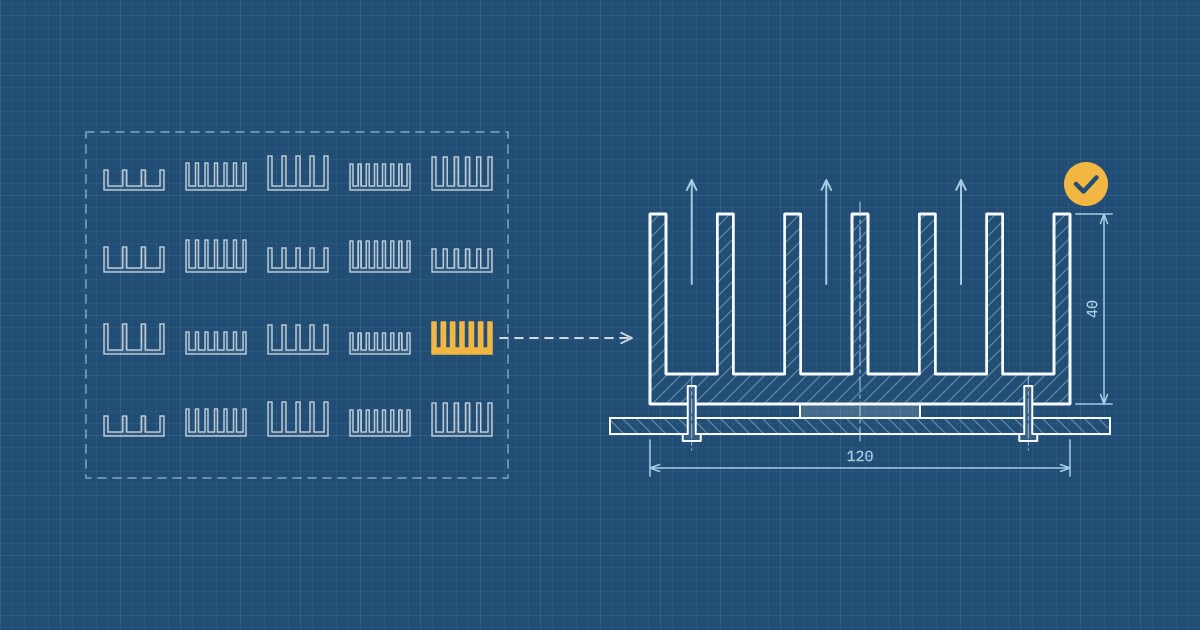
Machine learning changes that arithmetic. Follow one part through it, number by number. It's a heat sink for a motor controller in a sealed box, an aluminum base with a row of fins that has to keep the electronics cool without getting too heavy or too expensive to make.
5 numbers describe the design
#Fin count, fin height, fin thickness, the gap between the fins and the thickness of the base. Change any of them and the temperature of the electronics changes, often in ways that pull against each other. More fins give the heat more surface to leave from, but packed too tightly they choke the airflow between them. A thicker base spreads the heat better but adds weight.
Five numbers, each with a sensible range, already make far more combinations than anyone could simulate one by one.
40 minutes for each answer
#A detailed thermal simulation of one design, with the air flowing through the fins, takes about 40 minutes. That's fast enough to check a design properly, and much too slow to search through thousands. At that pace, a working week covers about 60 designs, picked by experience and a fair amount of guesswork.
300 to learn from
#Instead, the first step is to run a few hundred simulations, spread evenly across all the combinations rather than clustered around a favorite. They run in parallel and unattended, over a night or two. Each one pairs five input numbers with the temperature that came out.
From those pairs, a model learns how the five numbers relate to the temperature. It doesn't solve the physics. It learns the pattern the physics produced, well enough to predict the result for designs that were never simulated.
10,000 in a few minutes
#Now each new design takes a fraction of a second instead of 40 minutes. Ten thousand candidates take a few minutes, and the question can shift from "is this design good enough?" to "what's the best design within our limits?"
The limits matter as much as the temperature. The fins have to fit in the box, the weight has a ceiling, and some fin shapes are cheaper to make than others. All of it can be applied at once, and what comes back isn't a single answer but a picture of the trade-offs. It shows how much cooler the electronics could run for every extra 100 grams, and where adding more stops helping.
4 worth a closer look
#A model trained on simulations is an excellent guide and a poor judge. It's most reliable in the middle of what it was taught and least reliable at the edges, and the best designs often sit at an edge. So the four strongest candidates go back through the full, detailed simulation, the slow kind, to confirm the model was right.
Usually it is, or close. When it isn't, that simulation becomes one more example, the model is retrained and the search runs again. After a few rounds, the model is sharpest exactly where it matters.
1 to make
#In the end, one design gets made and tested for real, in the box, with the motor running at full load. It's the same final step as always. What's different is how much ground was covered before it. Ten thousand designs were considered instead of sixty, and the choice is backed by the whole range of options rather than the few someone had time to try.
The model keeps paying off afterwards. When a larger version of the motor controller needs its own heat sink, most of the learning is already done.
When it pays off
#A model like this is worth building when a design has many numbers to tune, when the same kind of part comes in many sizes or when the same question keeps coming back. For a single part with two or three choices, a handful of ordinary simulations is still the quicker answer.
Either way, the result rests on simulations you can trust and a real test at the end. The model only decides how many designs you get to consider before that test.