Prototyping
Proof of concept, prototype or product?
“Prototype” gets stretched a long way. Some people mean a single mechanism screwed to a board. Others mean something that's nearly ready for a factory. Those are very different pieces of work, and building the wrong one is a reliable way to spend money without learning much.
Three of the outcomes you can pick in Get started are proof that it works, a working prototype and a product ready to release. The first is usually called a proof of concept, so that's the name we'll use here. To show what separates the three, we'll invent a product and take it through all of them. It's a cordless desk lamp with the battery hidden in its base, bright enough to work by and lasting a full working day between charges.
First, the light and the battery
#The lamp's hardest promise is a whole working day of good light from a battery that fits in the base. If that can't be done, there's no product, however good the lamp looks.
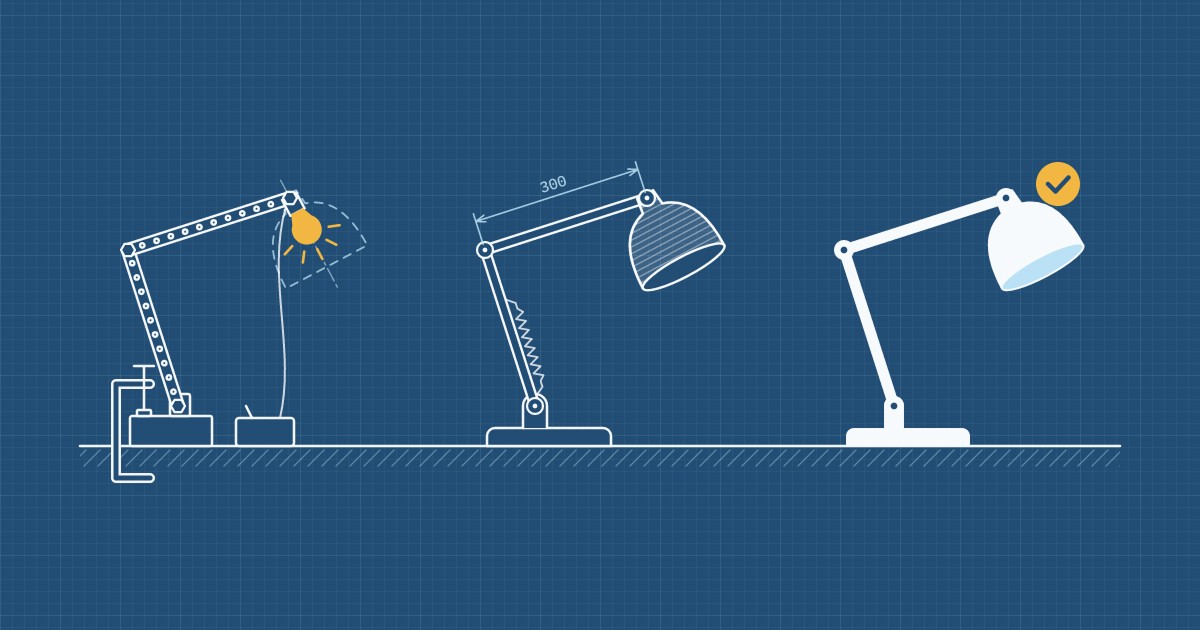
A proof of concept goes straight for that promise and ignores the rest. Here it could be a bare light and a battery on two strips of perforated metal, bolted into roughly the lamp's shape. Clamped to a table, it puts the light where it will sit in the finished lamp. Then you measure how much light reaches the desk and leave it on until the battery dies. It's allowed to be ugly, and it should be cheap.
You get a plain yes or no, though a no may only rule out this particular way of doing it. Whether anyone wants a cordless desk lamp, and what one would cost to make, are questions for later.
The whole lamp, on real desks
#Once the core works, the questions get bigger. A working prototype is the whole lamp at its real size and shape. The arm, the shade, the electronics and the software that dims the light and manages the battery all have to work together. Then it goes on a handful of real desks for a few weeks.
That's where the problems nobody thought of show up. Someone fits a heavier shade, and the head starts to sink because the spring in the arm was only ever meant to hold the lighter one. Stretched all the way out, the lamp tips over. The touch control switches it on whenever the desk gets wiped. And when the battery is nearly flat, the light cuts out in the middle of a video call, when it should have dimmed a little first as a warning.
The same lamp, thousands of times
#A prototype is usually built by hand in small numbers, from parts made whichever way was quickest. A product ready to release has to be made thousands of times and still work on every desk it ends up on.
For the lamp, that means parts that can be made in volume, and an arm that balances even though no two deliveries of springs are exactly alike. It has to be quick to assemble and cost little enough per unit to leave room for a price people will pay, and it has to be designed to pass the tests and approvals required before it can be sold. The battery adds a few of those. Then there are the lamps already sold: what happens when one won't charge, and whether a worn-out battery can be replaced or the whole lamp ends up in the bin.
This is the most expensive stage to reach and the most expensive to get wrong. The lamps themselves will usually come off someone else's production line, so “ready” means ready to hand over without surprises.
Choosing where to start
#Work backwards from what you'll do with the answer. If you're deciding whether the idea deserves serious money at all, and nobody has shown the core works, you need a proof of concept. If the core holds up and the decision depends on people, like whether users want it or a retailer will stock it, you need a working prototype. And if you're about to sign with a manufacturer and pay for production tooling, it's a product ready to release.
Where you are today matters too. A rough rig that already does the one hard thing reliably may well be your proof of concept. A prototype that only you have used probably leaves you further from the finish than you think.
The classic mistakes go both ways. One is building for production before anyone knows the core holds up. The other is polishing a proof of concept long after it has answered its question, because the next step feels big.
The stages also overlap more than this makes them sound. A good proof of concept often becomes the heart of the prototype that follows, and a prototype built with production in mind saves work further down the line. Because we work at every one of these stages, a project can move on as the answers come in, with the same people and nothing to re-explain.
If you're still unsure
#Tell us what the product should do and what you need to decide next, and we'll suggest where to start. If that's a smaller first step than you expected, we'll say so.
For the lamp, it would have been enough to start with a bare light, a battery and two strips of metal clamped to a table. It wouldn't have looked like much, and it wouldn't have needed to.