Prototyping
Electronics, mechanics and software in one prototype
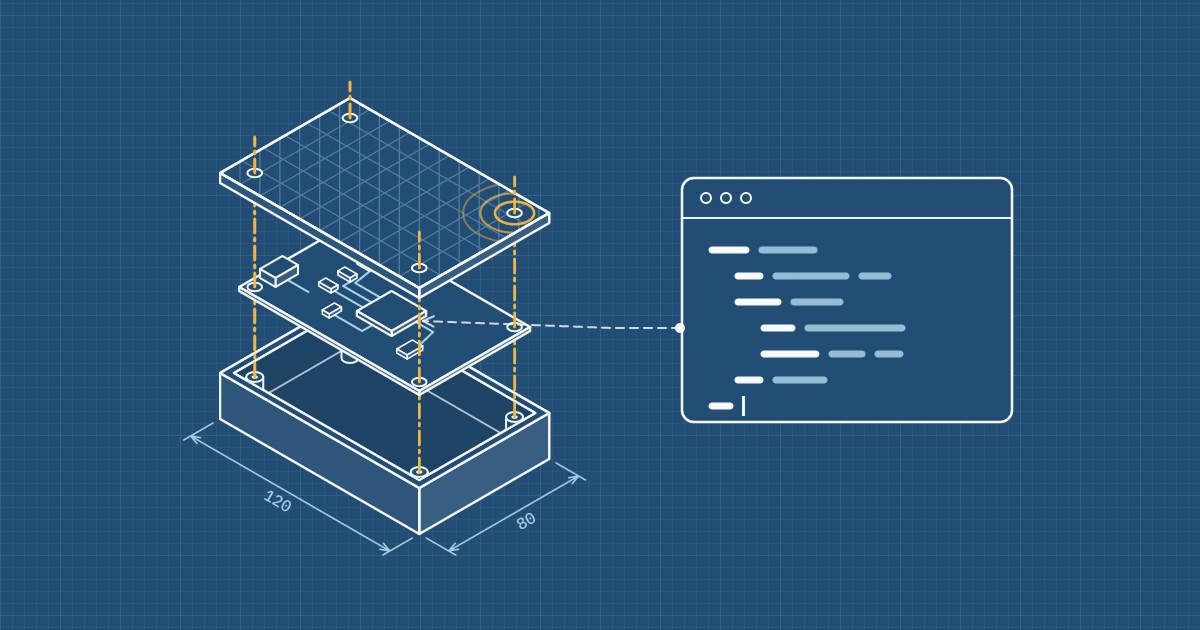
Very few products are just one thing. A connected device has electronics, a physical body around them, software that makes it all work and often an app or a system it talks to. Each of those is a discipline of its own, with its own methods and its own specialists. And the hardest problems in a prototype tend to show up where they meet.
The problems live in the seams
#Each part of a product can be right on its own and still be wrong together with the others. A few familiar examples:
- The circuit board is finished, but a connector ends up exactly where the enclosure needs a screw.
- The wireless connection works fine on the bench, then loses range once everything is packed inside the enclosure.
- The battery was sized for one way of working, and the software ends up using far more power than anyone planned for.
- The seal that keeps water out also keeps heat in, and the electronics run hotter than they should.
- The button feels wrong, because the parts on either side of it were designed by people who never compared notes.
None of these is hard to fix on its own. What makes them expensive is finding them late, after each part has been finished and signed off separately.
Every handover is a chance to lose something
#When different suppliers each own one part, every decision that affects more than one of them turns into a specification, a meeting or a long email thread. Each side does good work within its own part, but nobody owns the whole. Small mismatches slip through and only surface when the pieces come together for the first time, which is often the most expensive moment to find them.
With us, the whole product is designed in one place, and we own what would otherwise fall between the cracks: making the pieces fit.
Four areas, one partner
#Electronics
#The hardware that lets a product sense, react and connect, designed from the start to fit the enclosure and the software around it.
Mechanical design
#The physical product: what you hold, what moves and what protects everything inside, designed so it can be made.
Software
#The code that makes the product do its job, on the device itself and around it.
Simulation and testing
#Evidence that a design holds up, first in simulation before anything is made, then on the prototype itself.
What each area involves depends on your product, and it's something we work out with you rather than decide in advance. Read more about what we help with.
These aren't separate departments. Marcus works across electronics, mechanics and software, so the hardware and the code that runs it come from the same person. David brings more than 30 years of simulation experience and makes sure a design holds up before anything is made. Madeleine makes sure the result is presented as carefully as it's made.
An example: a sensor that lives outdoors
#Picture a hypothetical product: a small, battery-powered sensor that sits outdoors, measures something and reports to an app. Almost every important question about it crosses at least two disciplines:
- How long does the battery last? It depends on how often the device wakes up and sends data, and that depends on what the app needs to show. Together they decide how big the battery has to be, and with it the enclosure.
- Does it survive the rain? That's a question for the enclosure and how it's sealed, but keeping water out also affects how heat gets out, and the enclosure's shape can affect the wireless range.
- Does it stay put in the wind? The mounting and the enclosure can be checked in simulation first, then tested on the prototype.
When the whole product is designed in one place, a change in one part is checked against the others as it happens. If the enclosure has to grow, whoever designs the electronics knows straight away. If the device reports less often to save battery, the app is changed to show when the last reading came in, instead of pretending to be live. Nobody waits for a meeting to find out.
When you don't need all of it
#Not every project needs all four. If your own team already has the electronics covered, we can take on the mechanics and the simulations, or join your team as an extra pair of hands. Knowing the other disciplines still pays off, because we see how our part affects yours.
We take your product as far as you need, whether that's proof the idea works, a working prototype or a product ready to release, and agree with you early on where that line falls, including when it's time to bring in a manufacturer for volume production.